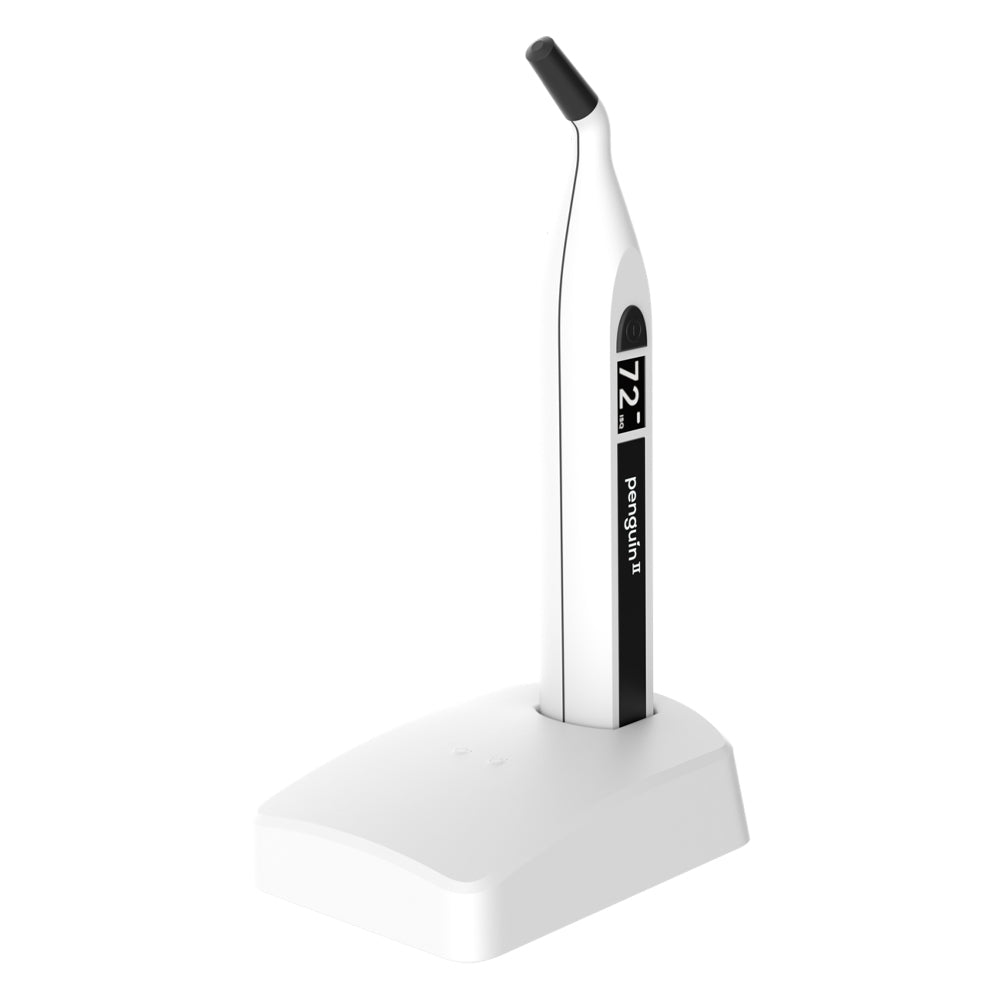
Penguin RFA & Penguin II - ISQ Implant Stability
SKU:RFA-55250
Couldn't load pickup availability
Professional Use Only. This product is intended for use by licensed dental professionals only. By purchasing this item, you certify that you are a qualified practitioner and that this product will be used in accordance with local regulations and professional standards. Verification of professional credentials may be required prior to shipment.
- Vendor:
- Tags: Dental implants, Implant stability, Implant stability quotient, Isq, Multi-pegs, Osstell, Penguin
About the Product
The Penguin RFA and Penguin ISQ systems offer a practical, contact-free way to measure dental implant stability using Implant Stability Quotient (ISQ) values. Designed for everyday clinical use, these devices help clinicians assess osseointegration with confidence and make informed decisions about implant loading.
The Penguin RFA implant stability tester allows clinicians to evaluate implant stability at multiple stages of treatment, including immediate placement, healing, and prior to final restoration. Measurements are taken without physical contact with the implant, helping reduce technique sensitivity while maintaining consistent results.
How the Penguin RFA System Works
Using resonance frequency analysis (RFA), the Penguin system generates clear ISQ readings that reflect implant stability over time. The device uses reusable, autoclaveable MultiPegs that are calibrated to individual implant brands and systems, allowing for accurate measurements across a wide range of implant platforms.
Key Benefits
- Objective ISQ values to support implant loading decisions
- Non-invasive, contact-free measurement
- Reusable MultiPegs designed for long-term clinical use
- Portable, lightweight design suited for any operatory
- Consistent performance trusted in implant dentistry
Who Is This System For?
The Penguin ISQ reader is well suited for general dentists, oral surgeons, and implant specialists who want a reliable way to monitor implant stability throughout treatment. It can be especially useful when determining whether an implant is ready for loading or when tracking stability changes over time.
A: MulTipegs are made from durable titanium with sealed magnets, and can be autoclaved for sterility. They are calibrated against a reference for consistent ISQ-values which in turn makes it easier to compare different implant systems. The laser marked MulTipegs are tissue friendly and leaves no foreign material inside the implants. They are also cost effective since they are reusable.
Q: Does Penguin II produce the same ISQ values as Osstell ISQ?
A: The Penguin II used together with the reusable MulTipegTM, give in principle the same ISQ readings as Osstell ISQ with the disposable SmartPegs. However, MulTipegs are calibrated against a common standard which means that the ISQ values are comparable between different implants. MulTipegs must be used to get the benefits of the calibrated system.
Q: Are the reusable MulTipegsTM compatible with the disposable Osstell SmartPegs?
A: Although the two systems in principle give the same ISQ values for an implant (however see the question above about the calibration standard), they are not directly compatible. If Penguin II is used with Osstell Smartpegs, the measurements need to be adjusted according to this table. If an Osstell instrument is used with MulTipegs, this table is used instead. This is because MulTipegsTM and Smartpegs® are made from different materials (titanium vs aluminum). MulTipegs must be used to get the benefits of the calibrated system.
Q: How many times can I use the reusable MulTipegTM ?
A: If a MulTipegTM is used, washed and autoclaved, it will mean some wear. Eventually, the MulTipegTM will be worn in such a way it should be replaced. How many uses that will take, differs dependent on the way it is handled, but in any case it is guaranteed for 20 autoclave cycles.
Q: What is the MulTipegTM material?
A: The reusable MulTipegTM is made in titanium, a highly biocompatible material which guarantees that no foreign material or substance comes in contact with the implant during the measurement.
Q: How do I work with the system under sterile conditions?
A: If the instrument is used together with a sterile cover, it can be used in a sterile environment. Both the MulTipeg and the MulTiPeg Driver are autoclavable.
Q: How long before the batteries have to be recharged?
A: Fully charged batteries will provide more than one hour of continuous measurements. Since the instrument normally is used only for a short while at a time, it means it can be used for many sessions before recharging.
Q: Which cut-off ISQ value should I strive for?
A: Dependent on the surgical protocol (one- or two-stage), loading protocol (immediate, early, standard, prolonged) and clinical situation (i.e. single tooth, full bridge), the ISQ value requirement differs.
Q: Is the method documented?
A: Resonance Frequency Analysis applied on implants is documented in more than 700 peer-reviewed published articles.
Q: Is the published Resonance Frequency Analysis (RFA) documentation valid for Penguin II?
A: The result of a measurement with the Penguin II instrument is presented as an ISQ-value. Internal research show that Penguin II together with MulTipegs produce the same results as other instruments for the measurement of ISQ.
The Penguin II system consists of a hand-held instrument and a reusable MulTipegTM. A charger is delivered together with the instrument as well as a stainless steel driver for attaching the MulTipegTM to the implant.
STEP 1
Select the correct MulTipegTM for the implant being measured.
STEP 2
Attach the MulTipegTM using the driver (approximately 6-8 Ncm of torque).
STEP 3
Turn on the instrument and hold the tip of the instrument close to the top of the MulTipegTM.
STEP 4
The instrument emits a beeping sound when it starts measuring and another sound when the ISQ value is presented on the display a second later.
- Stand-up wireless charging (charging base included);
- User-replaceable battery;
- Clearer dual displays;
- Rubberized grip for easier handling; and
- RFA Test Peg to verify device performance - NOT needed for calibration.
Battery Changes